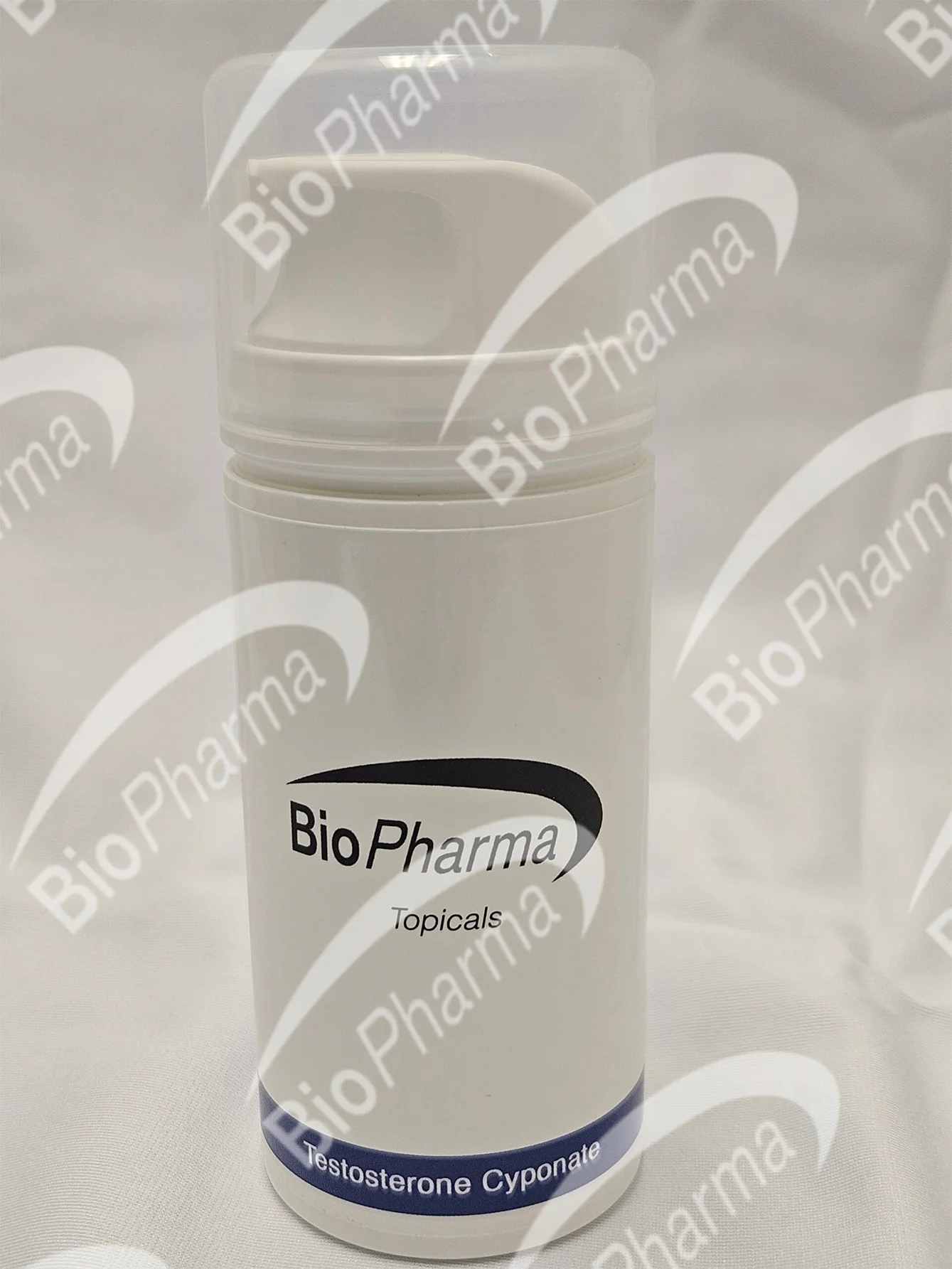
Description
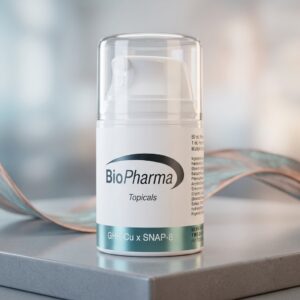
5000 MG/Bottle (50mg per pump)
WHAT IS THE CONCEPT BEHIND BIO PHARMA’S TOPICAL LINEUP?
What “nano-encapsulation” means
Imagine the active ingredient—testosterone, for example—is the passenger, and the nano-sized carrier is the vehicle.
Normally, your skin is designed to keep foreign substances out. Simply putting testosterone or another active ingredient into a cream doesn’t mean very much of it will make it through the skin and into circulation.
The product described here claims to put the active ingredient inside extremely small carrier structures—essentially microscopic/nanoscale packages. The idea is that these carriers improve how the ingredient disperses in the formulation and potentially improve its ability to cross the outer layers of the skin.
The diagram labeled “Target Compound” and “Water Soluble Cover” is trying to illustrate that concept: the active compound is contained within a carrier whose exterior interacts better with the surrounding formulation.
Why particle size matters—but isn’t the whole story
The page says its particles are under 50 nanometers (nm) and that particles below 150 nm penetrate skin efficiently.
For perspective, 1 nanometer is one-billionth of a meter, so 50 nm is extremely small.
However, there’s an important distinction: making something nanosized doesn’t automatically mean the active drug reaches the bloodstream. Skin penetration depends on the carrier chemistry, the drug itself, concentration, application site, skin condition, formulation and other factors.
So I wouldn’t interpret “under 50 nm” by itself as proof of high systemic absorption.
What they’re claiming is different about their testosterone topical
The page essentially says:
Traditional topical: Testosterone is placed in a conventional cream/gel/oil-based vehicle → some testosterone crosses the skin → some remains on or within the skin.
Their nano topical: Testosterone is incorporated into a nanoscale delivery system → the formulation is intended to move the testosterone through the skin more effectively → potentially more reaches systemic circulation.
That’s the basic idea.
The page goes further and claims 7–10× greater absorption than traditional topicals and results “on par with injectables.” Those are much stronger claims. I’d want to see the actual pharmacokinetic study—blood testosterone measurements over time, number of subjects, dose applied, application site, comparator formulation, etc.—before treating those numbers as established facts.
One thing I’d change in this explanation
The statement that because the body is “water based,” it sees oil-soluble compounds as “foreign objects,” while a water-soluble coating makes the compound “friendly,” is an oversimplification and not a good scientific explanation.
Your body handles both water-soluble and lipid-soluble molecules. In fact, the outer skin barrier contains a lot of lipids, and the ability of a drug to partition between water and lipids is an important part of transdermal delivery.
The more defensible explanation would be:
Nano-encapsulation is designed to improve the stability, dispersion and delivery of the active ingredient and potentially increase its penetration through the skin compared with a conventional topical formulation.
So the simple takeaway is: nano-encapsulation is the delivery technology; increased skin penetration is the goal; increased blood levels are what ultimately prove whether it worked. The concept is scientifically plausible, but the specific claims on this sheet—especially 7–10× absorption and injectable-like results—need clinical data to substantiate them.